

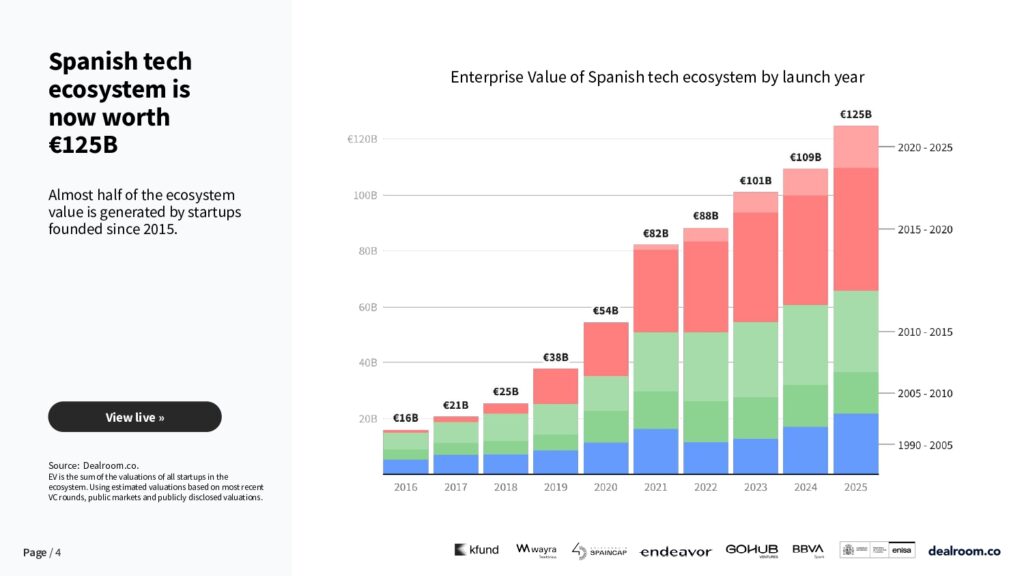
Spain’s tech ecosystem has now reached €125 billion in aggregate enterprise value, consolidating its position as the eighth largest in Europe. But the national figure carries particular relevance from Valencia’s perspective: the Valencian ecosystem closed 2025 with its best year ever for investment, raising €229 million and strengthening its role as Spain’s third major innovation hub.
This is reflected in The Spanish Tech Ecosystem Report 2026, prepared by Dealroom.co together with BBVA Spark, Kfund, Endeavor, GoHub Ventures, SpainCap, Wayra and Enisa, as well as in Entrepreneurial Ecosystem Diagnostics, published by the OECD.
Valencia has once again contributed to this momentum as Spain’s third leading innovation hub, achieving a record year in investment raised by Valencian startups: €229 million.
What the Dealroom and OECD reports say about the tech sector in Spain and Valencia
These are the main figures and takeaways from both reports. Further below, you can read our analysis and perspective on what they mean for the Valencian startup ecosystem.
– Spain’s tech ecosystem is worth €125 billion, a 2.3x increase since 2020, making it the eighth largest in Europe
– Spain is the second European country with the highest relative growth in enterprise value since 2020, also at 2.3x, behind only Belgium.
– Spanish startups raised €3.1 billion in VC investment in 2025, the third-best year on record, with early and breakout stages reaching historic highs.
– Almost one in five startups founded in Spain since 2021 is an AI company. Spain’s AI ecosystem has grown 3.7x since 2020, making it the third-fastest-growing in Europe in relative terms.
– Spain has a pipeline of more than 3,500 VC-backed companies and has already produced 40 companies with more than €100 million in revenue and/or valuations above €1 billion.
– The OECD positions Spain as one of Europe’s most dynamic entrepreneurial ecosystems, with a business creation rate above the European average and a business churn rate of 18%.
– The 2022 Startup Law and Enisa, with more than 8,300 companies financed and 2,100 certified startups, are recognised by the OECD as key institutional drivers.
From a Valencian perspective:
– Best year ever for investment: €229M in 2025. Valencia was the third Spanish city by investment volume raised in 2025, behind Madrid (€1.2B) and Barcelona (€1.1B).
– Valencia now has more than 1,689 active startups, after growing 11.3% year-on-year. In addition, three out of ten Valencian startups integrate artificial intelligence into their business model.
– The value of Valencia’s tech ecosystem has reached $3.9 billion, placing the city in the 81–90 range of the global ranking of emerging hubs.
– Valencia is already among the top 30 European hubs for performance, measured by exits and accumulated funding, and among the top 35 for affordable talent.
Health and Deep Tech startups, both strongly rooted in Valencia, are leading growth
Beyond the aggregate figures, the reports also make it possible to identify which sectors are truly driving the growth of Spain’s startup ecosystem and where Valencia stands within those trends.
Looking at the verticals leading the growth of Spain’s national startup ecosystem, two sectors stand out above the rest: Health and Deep Tech.
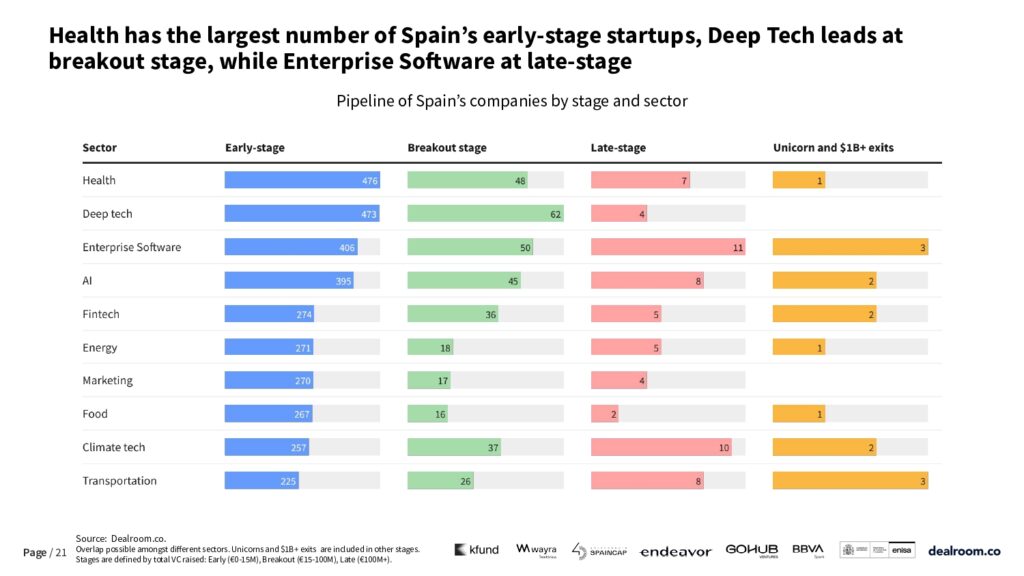
Health leads the early-stage startup category, with 476 companies. Deep Tech follows closely, with 473. At more mature stages, Deep Tech remains the main vertical among scaleups, while Enterprise Software, meaning B2B SaaS companies designed to solve business processes, dominates the lower end of the funnel with more than €1 billion in exit value. Both sectors also have a particularly strong presence within the Valencian ecosystem.
We recently published a detailed analysis on Digital Health in this same outlet, including an interview with Pablo Perea, Head of Investment at GoHub Ventures. In addition, one of last year’s largest rounds was the €50 million announced by Quibim, which uses AI to turn medical images into useful predictions.
In the case of Deep Tech, the other major transformation within Spain’s innovation ecosystem, Valencia has a long tradition of technology institutes and research centres that are closely connected to the business fabric, ensuring effective knowledge transfer and a clear focus on turning scientific research into scalable companies. This is reflected in the growth of startups linked to quantum computing, robotics, biotechnology, defense, another sector we have also covered extensively, and climate tech.
This last point is especially interesting because it represents a major opportunity for ecosystems such as Valencia. Unlike traditional SaaS, in Deep Tech the competitive advantage depends less on marketing or speed of execution, which are factors closely linked to available capital, and much more on scientific knowledge, engineering and intellectual property. In other words: talent.
Analysis and perspective on the Dealroom and OECD reports on the tech sector in Spain and Valencia
As Mayor María José Catalá said at the last VDS, “Valencia is competing in the major leagues of technological innovation and entrepreneurship, and it has the ambition to go further.” The data published in the reports mentioned above reinforces the scenario outlined by Catalá, while the analysis shared by some of the ecosystem’s leading experts suggests that this ambition to go further is entirely within reach. “The data shows that Valencia is consolidating its position as one of Europe’s most dynamic tech hubs,” also stated Juan Luis Hortelano, President of Startup Valencia, during the same event.
The main pillars of Valencia’s startup ecosystem are already clearly identified: technical universities capable of generating qualified talent, a solid industrial fabric, quality of life to attract and bring back talent, and more competitive operating costs than other major European hubs.
The next leap, however, depends on strengthening two factors: greater access to capital and a less conservative attitude towards the risk involved in entrepreneurship. These are precisely two of the three bottlenecks identified by the OECD report. The shortage of specialised tech profiles also exists, although Valencia starts from a comparatively favourable position thanks to its university, technical and research base.
But Valencia has the right roadmap to shorten the timeline. In terms of access to capital, the record figures from 2025 confirm the upward trend among Valencian startups when it comes to raising financial resources. Meanwhile, on the more cultural side of risk aversion, there are now increasingly more accelerators, training institutions and other organisations encouraging and facilitating entrepreneurship.
The rise of artificial intelligence may also play in favour of emerging hubs such as Valencia. In an environment where tech productivity is increasing dramatically, massive access to capital may become less decisive than in previous cycles, increasing the differentiating weight of talent.
In short, in a context of stability, without the disruptions experienced during the first half of the decade, namely the pandemic and the inflationary and supply crises resulting from the war in Ukraine, Valencia’s ecosystem of tech innovation and entrepreneurship is facing the greatest opportunity in its history to consolidate itself among the world’s leading hubs.