

Spain’s startup ecosystem enters 2026 from a position of greater maturity. Investment remains above pre-2021 levels, the number of funding rounds is increasing, and sectors such as artificial intelligence, biotechnology and space technologies are attracting a growing share of capital.
These are some of the conclusions of Spain Global Startup Hub 2026, the report published by ICEX Spain Trade and Investment analysing the investment market, the country’s main hubs, funding sources, internationalisation and the technology sectors with the greatest potential.
The data does not suggest a return to the investment peaks recorded after the pandemic, but rather the consolidation of a different stage. Capital volumes are stabilising, while the number of funding rounds is growing and mid- and later-stage investment is gaining momentum.
The main challenge is no longer simply to create more startups. The next stage will depend on how many companies can develop proprietary technology, turn it into competitive products, internationalise their revenue and continue growing from Spain.
A technology ecosystem valued at €125 billion
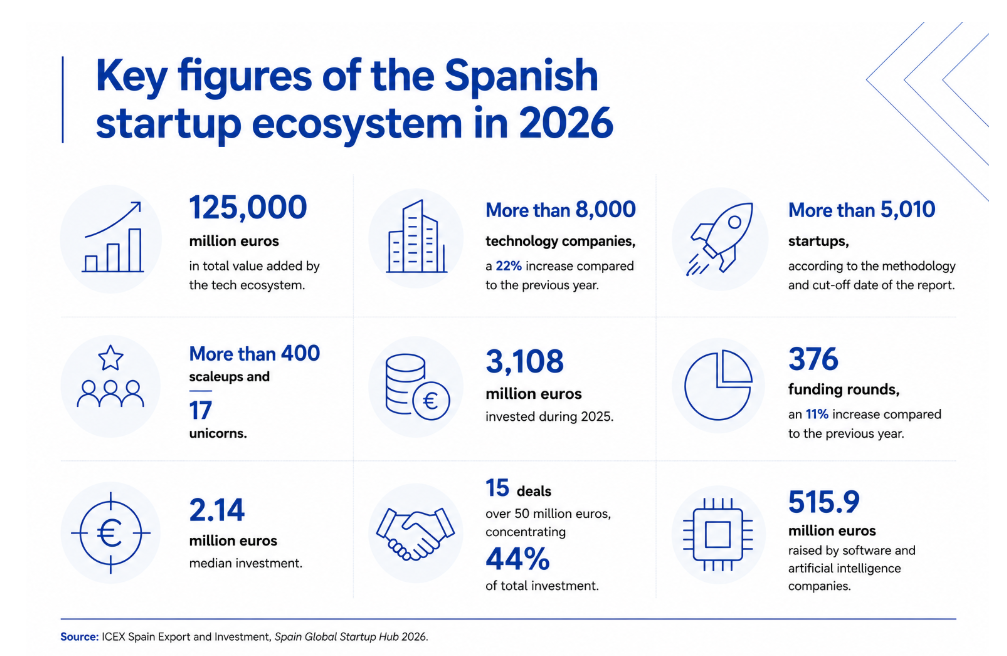
ICEX estimates the aggregate value of Spain’s technology ecosystem at €125 billion. According to the report, the combined valuation of the country’s startups has multiplied by 2.3 over the past five years, while Spain has attracted approximately €17 billion in venture capital since the pandemic.
Based on its methodology and cut-off date, the report identifies more than 8,000 technology companies, 22% more than the previous year, as well as more than 5,010 startups, 400 scaleups and 17 unicorns. These categories describe different segments of the business ecosystem and should not be added together.
This foundation is supported by a network of more than 60 technology parks and 284 incubators and accelerators, which are becoming increasingly specialised in areas such as health, biotechnology, industry, energy, mobility, tourism and science-based technologies.
The ecosystem is not only growing in size, but also becoming more complex. Alongside fast-growing digital startups, industrial, scientific and deep-tech companies are gaining prominence. These businesses require longer development cycles, highly specialised talent and larger volumes of funding.
This assessment is aligned with the remarks made by Carolina Rodríguez, CEO of Enisa, during the presentation of the Spain Tech Ecosystem Report 2026:
“Spain is emerging as one of Europe’s most dynamic innovation ecosystems. Dealroom’s data shows that we are consolidating our position as a robust and competitive entrepreneurial environment with a global outlook. This progress reflects the combined strength of entrepreneurs, private investment and strategic public financing instruments such as Enisa.”
The full statement is available in the information published by Enisa.
More funding rounds despite a slight decline in investment
Spanish startups raised €3.108 billion in 2025, according to data from Fundación Innovación Bankinter’s Startup Observatory, which ICEX uses as the main source for its investment analysis.
The total amount invested fell by 3% from the €3.197 billion recorded in 2024, but remained clearly above the €2.369 billion registered in 2023.
Activity moved in the opposite direction. A total of 376 funding rounds were completed during the year, an increase of 11%, indicating that capital was distributed across a larger number of companies.
The average deal size fell by 14% to €9.4 million, primarily due to a reduction in the size of the largest transactions. The median, however, increased by 34% to €2.14 million.
The median provides a more representative picture of the market’s overall development because it reduces the distortion caused by a small number of mega-rounds and reveals greater activity across the middle of the market.
The 15 transactions exceeding €50 million attracted a combined €1.354 billion, equivalent to 44% of all annual investment. Large rounds therefore continue to play a decisive role, although the increase in the median suggests that capital is becoming more broadly distributed.
Later-stage funding gains momentum
The distribution by investment stage reinforces the view that Spain’s ecosystem is becoming increasingly mature.
Series A rounds grew by 34% and Series C rounds by 65%, while Series B activity remained practically stable, declining by 3%.
The less positive signal comes from the earliest stages. Seed rounds fell by 10% to 89 transactions, marking the third consecutive year of decline.
The growth in Series A and Series C rounds indicates that more companies are successfully progressing from initial validation to expansion. However, the decline in seed-stage transactions highlights the need to maintain a sufficient flow of new projects to feed the future pipeline of scaleups.
The maturity of the ecosystem cannot be measured solely by the size of its largest companies. It also depends on its ability to continually renew its entrepreneurial base and enable new teams to access funding during the earliest stages.
Valencia strengthens its position on Spain’s technology map
The ICEX report identifies Valencia as one of the regional hubs gaining prominence through the growth of innovative companies, sector specialisation and the development of advanced technologies.
The presence of ARTHEx Biotech among Spain’s ten largest funding rounds of 2025 reinforces this trend. The Valencia-based company raised €73.9 million, making it one of the year’s largest transactions in biotechnology and life sciences.
Valencia’s technology ecosystem combines strengths in biotechnology, health, artificial intelligence, mobility, energy, industry and aerospace technologies. This diversity encourages connections between startups, universities, research and technology centres, investors, corporations and public institutions.
The growth and composition of the ecosystem are detailed in the Startup Observatory of the Valencian Community, produced by Startup Valencia in collaboration with the Generalitat Valenciana’s Regional Ministry of Innovation, Industry, Trade and Tourism. ICEX’s analysis complements other recent assessments of Valencia’s national and international position, including Startup Valencia’s article on the Dealroom and OECD reports.
“The report confirms that Spain’s startup ecosystem has entered a more mature stage. The next leap forward does not depend solely on creating more startups, but on enabling more companies to scale, internationalise and retain their decision-making centres and value creation in Spain. Valencia already has the talent, technology specialisation and companies required to compete globally,” says Nacho Mas, CEO of Startup Valencia and VDS.
Artificial intelligence and biotechnology lead investment
Software and artificial intelligence attracted the highest volume of sector-specific investment in 2025, with €515.9 million distributed across 60 transactions.
Artificial intelligence is no longer operating exclusively as a standalone category. It is becoming a cross-cutting technology embedded in products and services across health, finance, industry, productivity, mobility, tourism and cybersecurity.
Biotechnology and life sciences ranked second, attracting €345.5 million across 38 funding rounds. The total was almost four times higher than the amount recorded the previous year.
Business productivity companies raised €321.4 million; fintech and insurtech attracted €307.9 million; and travel and tourism secured €299.8 million.
The space and navigation sector also stands out, raising €151.3 million through only seven transactions. Satellite miniaturisation, advanced connectivity, data processing and artificial intelligence are lowering some barriers to entry and creating opportunities that extend far beyond space exploration.
These applications include telecommunications, Earth observation, agriculture, risk prevention and infrastructure management.
Deep tech: turning scientific knowledge into new industries
The report identifies deep tech as one of Spain’s major opportunities for developing new industries.
The country combines significant scientific output, STEM talent and an extensive network of universities, science parks, research centres and technology organisations. The opportunity spans advanced materials, photonics, microelectronics, quantum computing, industrial biotechnology, aerospace technologies and new energy sources.
The challenge lies in turning a greater proportion of this knowledge into intellectual property, marketable products and companies capable of competing internationally.
Deep-tech companies require more time to reach the market, face different technical risks from conventional software businesses and often need larger amounts of capital before generating significant revenue.
Their growth therefore depends on specialist funds, effective technology-transfer mechanisms and close collaboration between science, business and investment.
One of the instruments designed to address this gap is Innvierte Deep-Tech & Tech Transfer, promoted by CDTI Innovation and the European Investment Fund.
The programme has a combined allocation of €353 million to channel investment towards funds specialising in deep technologies and the transfer of knowledge from research centres to the market.
Spain expands its connections with Europe and Latin America
Internationalisation is one of the main areas examined in Spain Global Startup Hub 2026.
To assess it, ICEX analyses the geographical distribution of employees at Spain’s 100 highest-valued startups, using data from Crunchbase and LinkedIn.
This methodology provides an approximation of their priority markets, although it does not constitute a complete measurement of the companies’ international revenue, customers or business activity.
Mexico is the leading international destination for Spanish startups. The United States and the United Kingdom also occupy prominent positions, alongside Brazil, Argentina and Colombia. Within Europe, the leading markets include France, Italy, Portugal and Germany.
This distribution reflects a dual orientation. The European Union offers regulatory proximity and access to the single market, while Latin America provides greater cultural, linguistic and business affinity.
ICEX also presents Spain as a strategic platform for Latin American startups seeking to enter Europe. Establishing operations in the country allows them to work within the European Union’s regulatory framework and access a market of more than 400 million consumers from a familiar cultural and business environment.
The connection also extends to capital. Spanish funds participate in international transactions, while foreign investors play a particularly important role in later-stage funding rounds involving Spanish companies.
These cross-border flows become decisive when startups require larger tickets, access to new markets and international commercial networks.
New structures for financing growth
Equity remains the main funding instrument and was used as the sole structure in 69% of the funding rounds analysed.
Mixed transactions combining equity and debt represented 23%; rounds funded exclusively through public financing accounted for 5%; and debt-only transactions represented 3%.
The rise of hybrid structures reflects a specific need. Companies that have already validated their business models need to finance longer periods of expansion, but do not always want to meet all their funding requirements through equity rounds that dilute existing shareholders.
It is also important to distinguish between the structure of each funding round and the types of investors involved. Public funds participated in 115 transactions, corporate venture capital was involved in 97 and business angels took part in 69.
Instruments such as venture debt, participating loans and public-private co-investment are broadening the available alternatives, particularly for industrial, scientific and technology companies with greater capital requirements.
From open innovation to commercial contracts
Large corporations have a role that extends beyond investment.
Collaboration with an established company allows a startup to validate its technology in a real-world environment, secure an initial commercial reference and use that experience to access new customers and markets.
The problem arises when open-innovation programmes are limited to proofs of concept that are never integrated into the corporation’s operations.
The next stage requires more pilots to be converted into contracts, solutions to be deployed across different business units and recurring commercial relationships to be established.
Open innovation creates genuine impact when it stops functioning as a showcase and becomes part of the company’s business strategy.
The challenge is no longer just creating startups, but producing more scaleups
Spain’s ecosystem now includes more technology companies, greater sector specialisation, more diverse financial instruments and stronger international connections.
However, its next leap forward will depend on its ability to produce more companies at scale.
Startups will need to strengthen their intellectual property, build advantages that are difficult to replicate and generate international revenue. Spanish funds will need to increase in size and develop the capacity to support companies through successive funding rounds.
Corporations must convert open innovation into stable commercial relationships, while the public sector will need to continue reducing part of the risk associated with technologies that have longer development cycles.
The quality of teams and the decisions made during the earliest stages will remain equally decisive.
Enrique Linares, co-founder of letgo and founding partner of Plus Partners, has argued that many startups do not fail because of their technology, but because of decisions related to people, leadership and focus during their first years.
“That is why at Plus Partners we do not only invest capital; we stay very close to founders at the moments when they feel most alone and when the right support can have the greatest impact,” Linares explains in an article published by Cinco Días.
The 2025 data points towards greater maturity: investment is stabilising, the number of funding rounds is increasing, and mid- and later-stage transactions are gaining momentum.
This is not the accelerated growth experienced after the pandemic. It is a different stage, in which the ability to execute, develop proprietary technology, internationalise and scale matters more than volume alone.
Spain already has talent, scientific knowledge, technology companies, financing instruments and a favourable position connecting Europe and Latin America.
The next stage will depend on its ability to turn these advantages into global companies that generate employment, knowledge and value from Spain.
Read the full Spain Global Startup Hub 2026 report and explore all the data on investment, internationalisation, financing and technology sectors in Spain.