
Startup Valencia and EY-Parthenon have produced the Economic & Startup Ecosystem Impact report, which analyses the economic impact of VDS 2025, its return on investment and its contribution to the development of the entrepreneurial ecosystem.
The results of the latest edition place the economic impact generated in Valencia at 26 million euros, the highest figure ever reached. This growth also coincides with other indicators showing the evolution of the Valencian technology ecosystem, its capacity to attract investment and the consolidation of companies capable of competing in international markets.
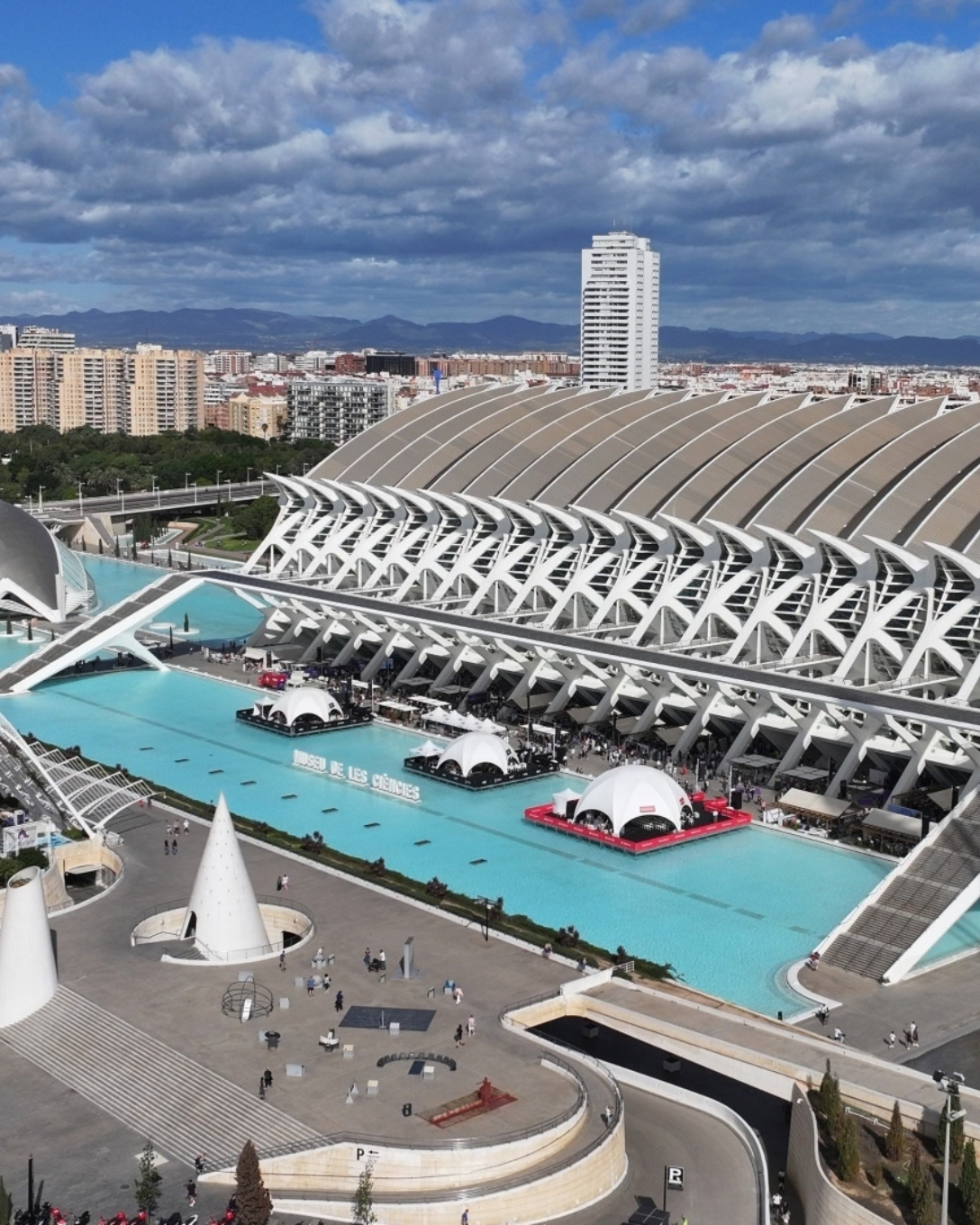
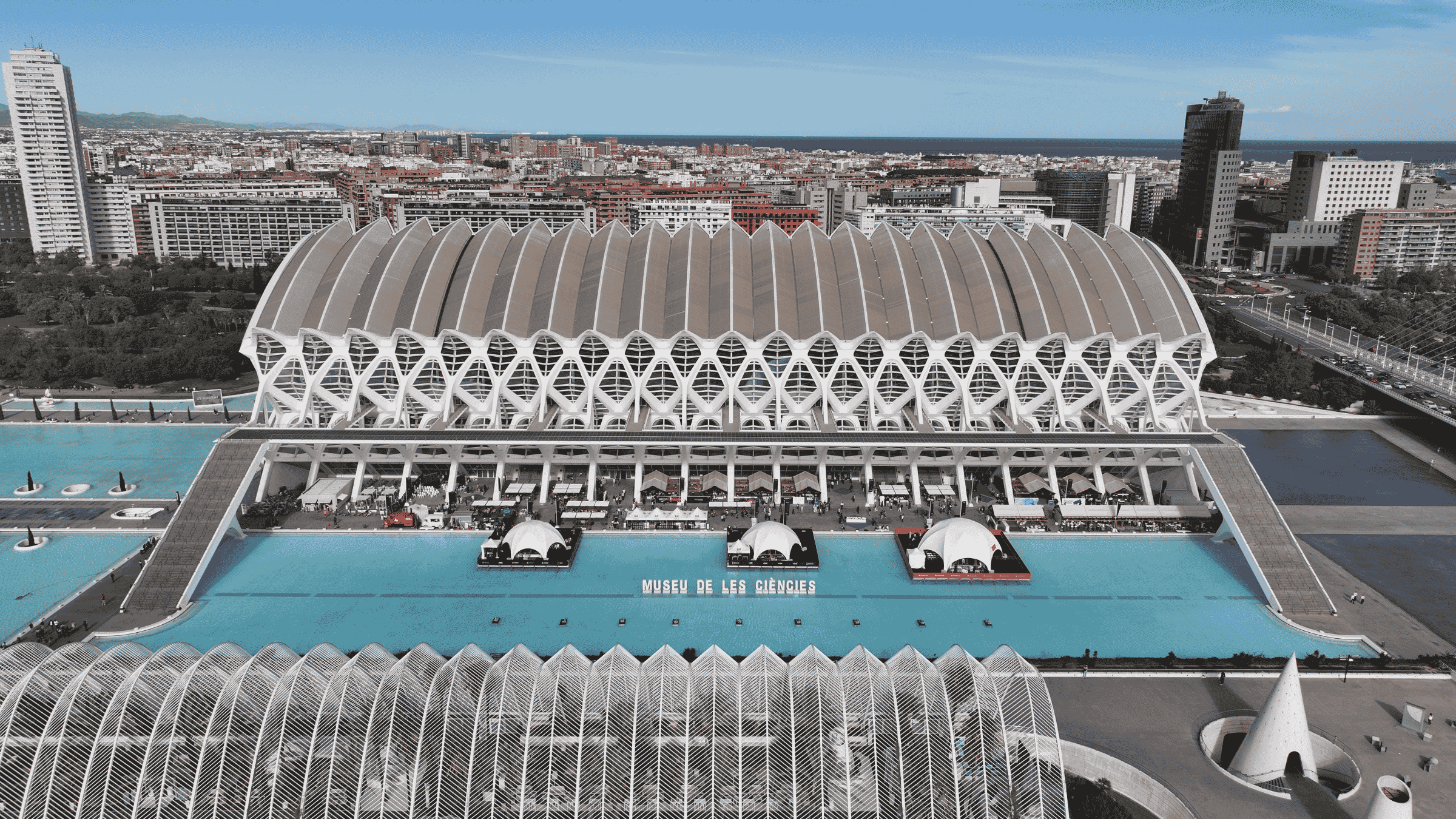
Organised by Startup Valencia since 2018 at the Ciudad de las Artes y las Ciencias, VDS has become one of Europe’s leading international technology events. Each edition brings together thousands of startups and scaleups, large corporations, investors, leaders and institutional representatives, while projecting Valencia as a global innovation hub and as a business bridge between Europe, Latin America and the United States.
Its value proposition is built on something concrete: high-value business connections. VDS brings together in one space those who can invest, hire, open markets or activate new collaborations. The report measures what happens when those conversations stop being one-off contacts and become agreements, funding rounds, clients or shared projects.
The VDS 2025 Impact Report: 26 million euros and a 14x return
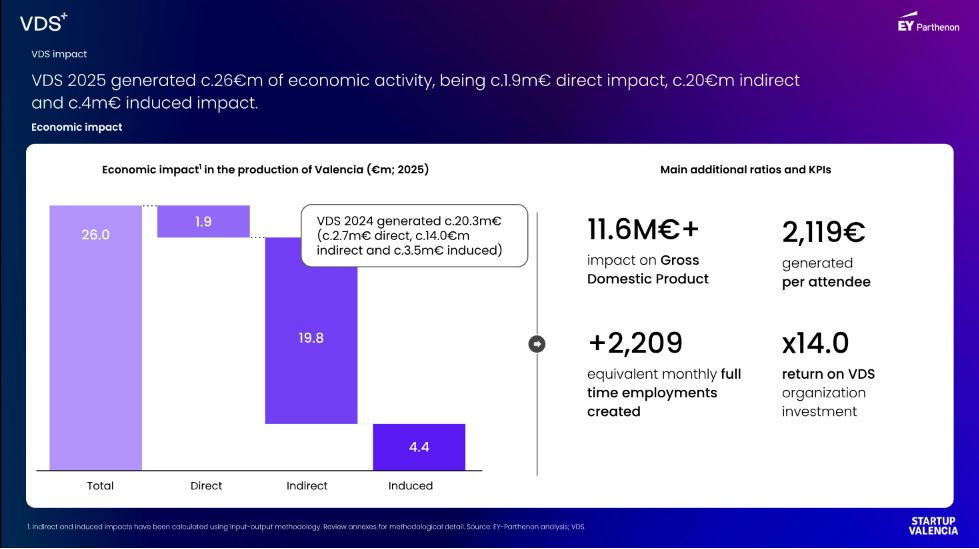
The 2025 edition generated 26 million euros of economic activity in Valencia, 29% more than the previous edition, whose impact was 20.3 million.
The report breaks this figure down into approximately 1.9 million euros of direct impact, corresponding to expenditure and investments made by the organisation; 19.8 million of indirect impact, derived from the activity generated by the organisation and attendees; and 4.4 million of induced impact, related to consumption associated with the employment and income activated by the two previous effects.
The contribution to Gross Domestic Product exceeded 11.6 million euros. This figure should not be confused with the total economic impact, as they are different magnitudes within the analysis.
Another of the most relevant results is the return obtained on the investment used to organise the event. For every euro invested in VDS, the Valencian economy received 14 euros of economic return. In 2024, the multiplier had stood at 7.4, meaning the capacity to transform investment into economic activity practically doubled in one edition.
Each of the more than 12,000 professional attendees generated an average of 2,119 euros of economic activity. The study also calculates that VDS contributed to generating the equivalent of more than 2,209 full-time monthly jobs, according to the methodology applied by EY-Parthenon.
The data goes beyond the visibility achieved by Valencia. It shows measurable economic activity and the evolution of a model that has gained scale and efficiency over successive editions.
More than 12,000 professionals, 800 investors and 3,000 startups at VDS 2025
VDS 2025 brought together more than 12,000 professionals from over 120 countries, along with 3,000 startups, 1,500 corporations, 800 investors and more than 600 speakers.
The number of startups increased from more than 2,500 registered in 2024 to over 3,000 in 2025. Investor presence also grew, rising from more than 700 investors to more than 800. At the same time, the assets managed by the investment entities represented increased from 250 billion to more than 300 billion euros.
The significance of these figures does not lie solely in the volume. Their true value lies in the connections they make possible. A startup can find funding, access a new client, open a market or establish a relationship capable of transforming its trajectory.
The report estimates that participating startups expected to raise more than 560 million euros in funding after VDS 2025. Within that forecast, more than 50 million euros are directly linked to opportunities that emerged during the edition.
Since the first VDS in 2018, startups that have participated in any of its editions have collectively raised more than 26.75 billion euros. This amount does not represent funding closed exclusively within the event, but the capital subsequently accumulated by the companies that have passed through it. Even so, it allows us to gauge the quality and potential of the projects that arrive in Valencia each year.
A Startup Competition with 1,246 applications from 84 countries
The VDS Startup Competition of 2025 received 1,246 applications from 84 countries. In 2023, 600 projects had been submitted from 48 countries, meaning participation doubled in two years.
Of all the applications received, 50 startups were selected to participate in the competition and only ten reached the final phase, five in the Early Stage category and five in Growth Stage.
The VDS 2025 winners were Spacebackend, from Luxembourg, in Early Stage, and Zibra AI, from Ukraine, in Growth Stage.
Spacebackend develops a cloud platform to integrate, operate and manage satellite payloads. Its technology aims to reduce the complexity of space missions and shorten the time needed to launch them.
Zibra AI creates artificial intelligence tools to generate 3D content and visual effects in real time, particularly aimed at the video game industry and audiovisual production. Its solutions allow elements such as liquids, smoke or fire to be simulated more efficiently.
They are two companies from different sectors, but they share the combination of proprietary technology, scalability and international ambition that the competition seeks.
The Valencian technology ecosystem reaches 7.3 billion euros
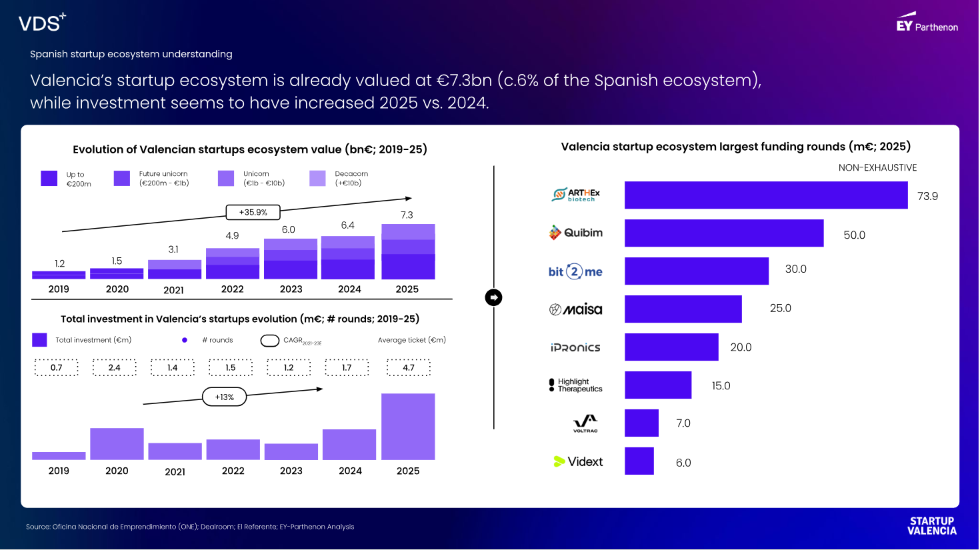
The report places the value of the Valencian startup ecosystem at 7.3 billion euros, approximately 6% of the national ecosystem. Between 2019 and 2025 it recorded a compound annual growth rate of 35.9%, rising from 1.2 billion to the current 7.3 billion.
The main Valencian operations of 2025 also reflect the diversity achieved. ARTHEx Biotech led a round of 73.9 million euros; Quibim, one of 50 million; Bit2Me, of 30 million; and Maisa, of 25 million. These were joined by operations such as those of iPronics, Highlight Therapeutics, Veratrak and Vidext.
The presence of the Valencian ecosystem is also reflected in recognitions published during 2026. Six companies from the Valencian Community were included among the 50 fastest-growing technology companies in Spain within the Deloitte Technology Fast 50 Programme 2026.
The six selected Valencian scaleups were Fourvenues, Imperia, CubicUp, Sesame HR, Auona and Embention. Fourvenues occupied third place nationally with a cumulative revenue growth of 2,276%. Imperia ranked seventh with 1,476%, while CubicUp reached 14th place with 767% and Sesame HR 24th place with growth of 375%.
Added to this recognition is the Top 26 startups to watch in 2026 selection, produced by El Referente with the participation of funds, accelerators and specialised professionals.
Among the selected companies are six projects linked to the Valencian ecosystem: Brambas, Eaship, IONLY Batteries, MA Education, Maisa and Your Friends Are Boring. The list brings together proposals from areas as diverse as logistics, energy, education, artificial intelligence, tourism and sustainable footwear.
These appearances are not isolated facts. They reflect the capacity of the Valencian Community to generate technology and innovation projects with traction, scalable models and real possibilities of competing beyond its borders.
The Spanish startup ecosystem exceeds 132 billion euros
The EY-Parthenon study does not limit itself to analysing the impact of VDS. It also examines the context in which the event takes place and the recent evolution of the Spanish startup ecosystem.
The aggregate value of Spanish startups reached 132.4 billion euros in 2025. Spain was the third fastest-growing ecosystem in the European Union between 2020 and 2025, only behind Belgium and Ireland, and occupied fourth place in the EU by venture capital investment.
Total investment in Spanish startups rose from 1.904 billion euros in 2024 to 3.022 billion in 2025, representing an increase of 59%. The average amount per round increased from 2.5 to 5.8 million euros.
The distribution of operations is also changing. Rounds above four million euros represented approximately 24% of the total in 2025, compared to around 8% recorded in 2019. The ecosystem still needs more advanced operations, but the data shows progressive maturation and a greater presence of mid and large-size rounds.
Artificial intelligence leads technology investment in Spain
Artificial intelligence has established itself as the leading venture capital investment segment in Spain since 2024, ahead of areas such as climate tech, tourism, biotech, medical devices and payments.
The report dedicates special attention to agentic AI, a new generation of systems capable of working with defined objectives, planning actions, making decisions based on context and executing complex processes with a lower level of human supervision.
EY-Parthenon estimates that the global market for advisory, implementation and maintenance services linked to agentic AI could approach one trillion euros by 2040, within a maximum potential development scenario. EMEA would represent around 34% of the market, with an estimated value of between 250 and 340 billion euros.
Among the Spanish companies identified in this category is the Valencian Maisa, which in 2025 closed a round of 25 million euros and has accumulated more than 26 million in funding. The company develops autonomous agents capable of executing complete business processes with limited human supervision.
The growth of these types of projects shows that Spain is not only adopting artificial intelligence. It is also creating its own technology in some of the areas with the greatest capacity to transform how organisations operate.
An international technology event based on high-value connections
The growth of VDS is also explained by the role it has assumed within the ecosystem. It has become a space where startups, investors, corporations and public officials can directly access decision-makers and advance conversations that, outside the event, could take months.
This capacity to bring together the right players explains much of its impact. The connections continue in the form of meetings, commercial agreements, investment processes and shared projects that develop throughout the year.
VDS has moved from representing the Valencian technology ecosystem to becoming an international platform connected to some of the leading innovation and investment markets. Its position as a meeting point between Europe, Latin America and the United States also reinforces Valencia’s role as a global hub from which to create and scale new projects.
In 2025, professionals from more than 120 countries and more than 600 speakers participated. 45% of speakers came from abroad and more than 35% were women, while eight of the participants were founders of unicorn companies.
The international dimension of VDS broadens the opportunities available to local companies. Every investor who discovers a Valencian startup, every corporation that identifies a potential collaboration here and every professional who considers Valencia as a place to develop their career contributes to strengthening the ecosystem.
After eight editions, its economic and business impact can now be measured. The ninth edition of VDS, taking place on 21 and 22 October 2026 at the Ciudad de las Artes y las Ciencias in Valencia, will expand that reach, generate new connections and ensure that more companies and professionals find here a place from which to grow.
The 26 million euros of economic impact is a record figure. It also reflects the evolution of a project that has grown alongside Valencia and that today helps position it among the technology ecosystems with the greatest projection in Europe.